CLIENT: FANTASY
Multi-brand infotainment.
As an OEM moved its vehicle lines to Android Automotive OS, could one infotainment foundation carry many branded experiences — instead of building each car's system from scratch?
CLIENT
Fantasy New York - for an automotive OEM
ROLE
Automotive UX Designer (Contract)
TIMELINE
Aug - Oct 2020
New York, NY
DISCIPLINES
Heuristic evaluation, interaction design, HMI concepts
1
CHALLENGE
Many models, one foundation?
2
AUDIT
What the current system got wrong.
3
TRADE-OFFS
Android, legacy and brand.
4
CONCEPTS
Conservative and progressive.
5
OUTCOME
What I handed over.
Carmakers have traditionally built infotainment model by model. Android Automotive raised a new question: could one system scale across a whole brand portfolio?
The OEM was adopting Android Automotive OS across multiple vehicle lines. That opened a different way of working: a shared foundation that each brand and model could express in its own way, rather than a separate system for every car.
The strategy behind that question sat with Fantasy's leads and the OEM. I joined on a two-month contract for one part of it: auditing the existing HMI and designing infotainment concepts that showed what the idea could look like on screen.
01
CHALLENGE
02
AUDIT
Before proposing anything new, I audited what drivers were already using — and what would have to survive the move to Android.
METHOD A
Heuristic audit
Evaluated the OEM's in-vehicle HMI against usability heuristics, screen by screen.
METHOD B
Android guidelines
Mapped where Android Automotive's patterns could be adopted as-is, and where the brand could customise them.
METHOD C
Legacy & brand
Catalogued the legacy requirements and brand language each concept had to respect.


HMI HEURISTIC AUDIT
03
TRADE-OFFS
04
CONCEPTS
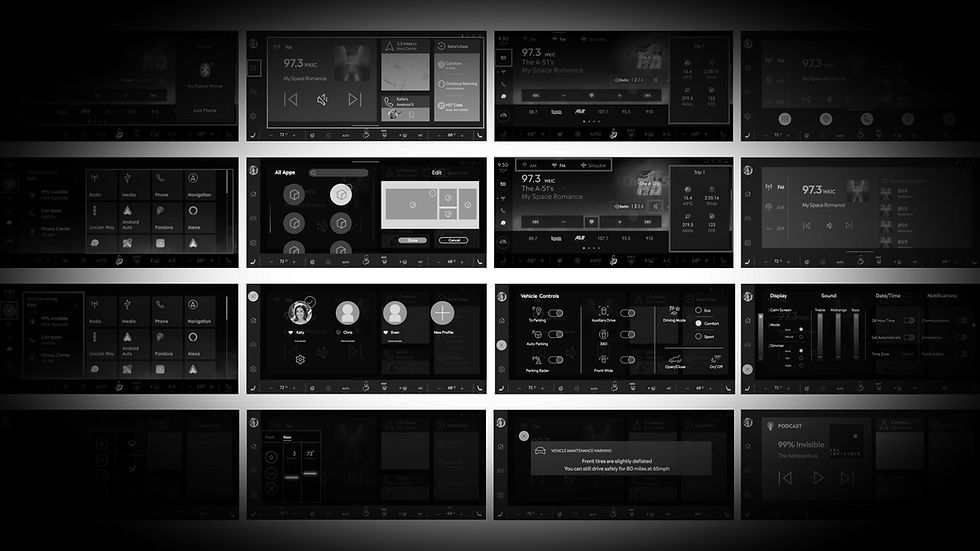
The concepts came in two directions, so stakeholders could see the trade-offs side by side.
Heuristic audit
EXISTING HMI
Conservative concept
AUDIT FIXES
Progressive concept
AAOS IN BRAND LANGUAGE
Refined concept
FINAL DIRECTION
DIRECTION A
Conservative
Keeps the existing system and fixes the usability issues the audit found. The smallest change, and the lowest risk.
DIRECTION B
Progressive
Rebuilds the experience on Android Automotive OS, expressed in the brand's own design language — showing what the move to Android could look like if the brand led it.


MEDIUM FIDELITY CONCEPT


05
OUTCOME
A refined infotainment concept, handed over at the end of the contract.
I didn't see what the OEM decided after my contract ended, so this page shows the work rather than claiming an impact: an audit of what wasn't working, and concepts that made the pull between Android, legacy and brand visible.
What I took from it: a first, hands-on look at designing within Android Automotive's rules — which I'd go on to ship with two years later.
Every screen I designed pulled three ways: what Android expects, what the legacy system required, and what made it feel like the brand.
NEXT CASE STUDY — 01 / 04 · VIRTUAL VEHICLE FOR PLATFORM SCIENCE